


Tabor has been hosting global programs for years. From backpacking around the Azores, Portugal to traveling to Denmark, global programs have brought Tabor students and faculty closer to global and cultural understanding.
While it’s nice to explore new countries and meet new friends from these journeys, have you ever stopped and wondered how these experiences came to be? Which trip was the first to start a new tradition of exploration around the world? And what does any of this have to do with a magazine?
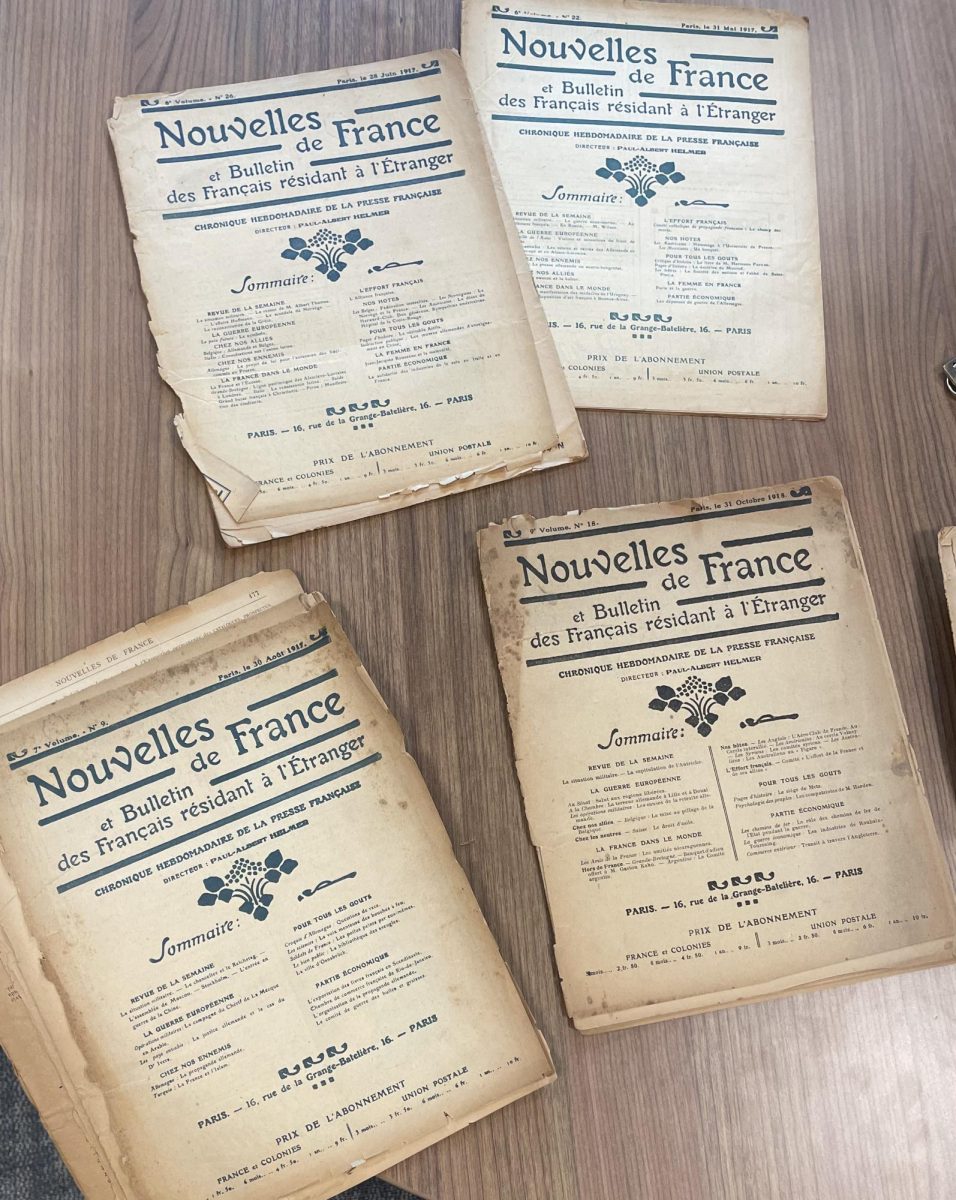
Well, Mr. William Beyreis, an English and French teacher, discovered an artifact that could be the key to Tabor’s global history. While at his desk in the language wing, he found French-language magazines from 1917-1919 at the very bottom. He brought them to Ms. Sophie Arnfield, Tabor’s archivist. She suspects that there is reason to believe that this magazine could be a link to one of the first international programs Tabor had.
I had to investigate this for myself and spent some time with Ms. Arnfield as well to discuss the first travel programs Tabor had to offer, and if this magazine could tie into any of the mysteries. Here is some of the information I was able to uncover.
For starters, it’s important to remember the time period during which this initial trip is taking place. In the early 1900’s, Tabor was very small, with a student body ranging from 43 to 51 students. Also, during this time, girls could only be day students, and even then, there weren’t many; hence, girls weren’t as active in these travel programs when they first started happening. Tabor was more focused on promoting Tabor as a boys’ prep school and potentially expanding Tabor’s enrollment on a national and international scale.
Speaking of international, was this program initiated during a time when Tabor had many international students? Well, that’s another factor that needs to be considered. Compared to Tabor today, the school didn’t have as steady an international student population. Yes, some students came from abroad, such as our first international student from Japan, and an international student from Russia; they were older and were at Tabor for a very specific reason. Unlike the international students we have today, who take the full Tabor curriculum and graduate during graduation, international students before this program did not do any of this, so they didn’t count as “international boarding students.” However, a little later, the school started to see more international students. An international student from China in 1921 was the first international graduate, and another student from Thailand graduated in 1928.
As for world events that have happened during this time, World War I is the most notable. The trip was occurring during the summer of 1919, after the war had ended; yet the effects of the war were still felt in France. It’s believed that Mr. Walter H. Lillard, who was the headmaster during this time, planned this trip with that knowledge in mind. When he was young, he was able to go abroad to Paris himself and later on go to Oxford in England as part of his college experience. As an educator, he wanted to link the exposure of new locations with educational lessons and values. Taking Tabor students abroad not only allowed them to use their nautical knowledge but also allowed them to experience firsthand the destruction they might have only heard about, ultimately gaining a better understanding of the world around them.
What was the program? And where did this Tabor crew go? Seven boys and Mr. Lillard went by boat to France from Boston, as planes clearly weren’t commercialized yet. The boat was a cargo boat that doubled as a passenger boat, but the Tabor crew was able to go aboard because they were expected to help with operations. Once in France, the Tabor participants were able to visit Paris, Versailles, and battle fronts from World War I.

Not only would the Tabor students apply knowledge that was taught in classes, but they would also be able to experience new cultures and languages. Mr. Lillard hoped that being able to bring youth together to gain unique perspectives would help bring about a better future. Mr. Lillard deliberately avoided taking the Tabor crew to “tourist attractions” and instead took them to places where they could gain new perspectives.

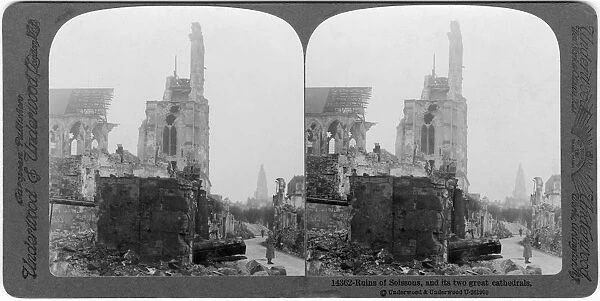
This program was a good launching pad to the eventual elaborate study abroad program we have now. A year after this initial journey, there was another trip called the “First Spring Cruise,” which brought Tabor students to new locations such as Cuba, Costa Rica, Mexico, and Puerto Rico, while of course having an option to go to France once more. On these trips still worked on the ships, but that practice faded as program grew and developed.
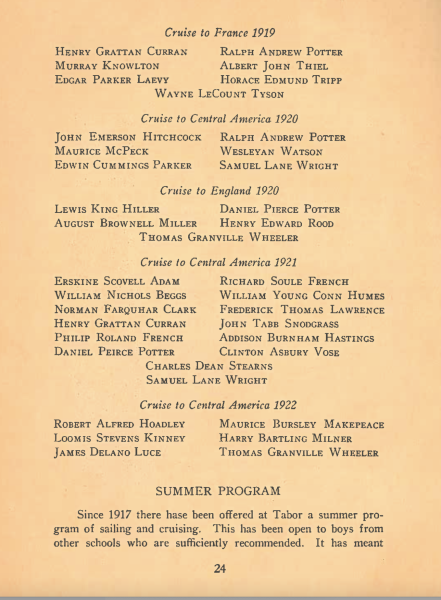
These trips benefitted not only the students who went on them but the school itself. Both local and Boston newspapers covered the trips. With new promotional value, an increase in students coming to Tabor, and the many headmasters since Mr. Lillard’s time, the program only grew. Eventually, exchange students from other countries joined the program, allowing students from abroad to visit Tabor themselves and Tabor students being able to do the same during spring and summer breaks.

Now, finally, after all this history…what does this have to do with the mysterious magazine? Well, to make a long answer short…it’s still a mystery. The connection to the magazine is still unclear and will probably remain so. However, due to this information, we can conduct very plausible theories! For starters, the magazine could have been a part of Mr. Lillard’s mail. Maybe since he had visited France before, he had some contacts who could provide sources such as the magazine that would reveal more about how France fared during and post-World War I. Another theory is that Mr. Lillard and the original seven boys who went to France simply got it while they were abroad and brought it back with them as a keepsake.
While the mystery surrounding the French magazine hidden in the language wing remains, one thing can be said based on its discovery: connection is the heart of the study abroad program at Tabor Academy. The program was built on the foundation of Mr. Lillard’s vision, his own connections from his own experience abroad, and his desire for his own students to understand that same joy.