










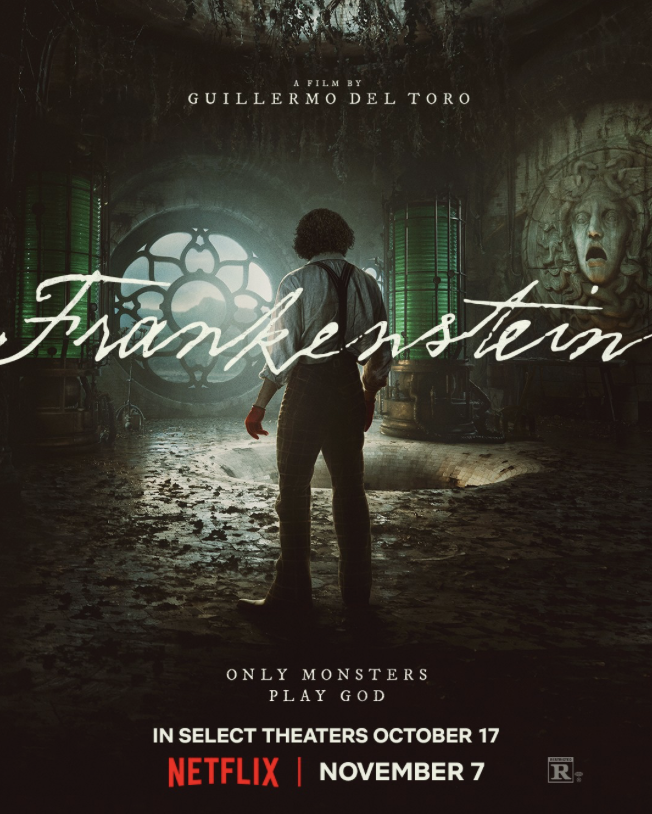
The newest adaptation of Frankenstein on Netflix begins with a simple but provocative question: can a centuries-old story about creation, ambition, and monstrosity still feel alive today? Directed by Guillermo del Toro and released in 2025, the film stars Oscar Isaac as Victor Frankenstein and Jacob Elordi as the Creature, with supporting roles by Mia Goth and Christoph Waltz. Overall, the movie is visually stunning and emotionally ambitious, offering a bold reimagining that is sometimes uneven but ultimately memorable. The film follows Victor Frankenstein, a brilliant yet dangerously obsessive scientist determined to defy the natural limits of life and death. When he succeeds in creating a living being out of the dead, he becomes horrified by what he has made. The Creature, confused and desperate for connection, becomes the center of the film’s emotional and moral conflict. Rather than relying on traditional horror elements, the movie focuses on themes of loneliness, rejection, and the human cost of unchecked ambition. It reframes the familiar story as a tragic exploration of what it truly means to be human.
One of the film’s strongest elements is its performances. Jacob Elordi delivers a deeply moving portrayal of the Creature, capturing both his childlike vulnerability and the pain of constant rejection. His performance makes the character feel heartbreakingly human. Oscar Isaac gives Victor an intense, almost frantic energy that reflects both his brilliance and his unraveling sanity. While some character arcs feel a bit rushed, the emotional core of the story—especially the Creature’s suffering—lands with force. Del Toro’s direction is unmistakably bold. He structures the film in “chapters,” echoing the layered narrative style of the original novel. His vision is sweeping and gothic, filled with elaborate sets and painterly visuals. At times, the script is thoughtful and engaging, but it occasionally becomes heavy-handed as it tries to juggle too many themes. Pacing can slow during long introspective moments, though the film never loses its emotional center.
Visually, the film is striking. The cinematography relies heavily on dramatic contrasts of light and shadow, creating a world that feels both eerie and beautiful. The set design is rich and immersive, with a dark romantic aesthetic that enhances the atmosphere. Some shots—especially those isolating the Creature in vast, empty landscapes—linger in the mind long after the movie ends. The sound design and score further heighten the experience without overwhelming it. Subtle ambient noises and restrained music work together to underline the Creature’s emotional turmoil and Victor’s descent into obsession. The sound never feels intrusive; instead, it deepens the film’s sense of tragedy and dread.
Ultimately, the film explores classic themes of humanity, responsibility, and alienation. It questions what makes someone a monster, their appearance or the way they are treated, and whether creation without compassion is doomed to lead to destruction. While not every thematic moment is perfectly executed, many of them strike with surprising power. My personal reaction was shaped most by the Creature’s emotional journey. His loneliness and yearning for acceptance made the film feel less like a horror story and more like a tragic character study. I felt genuinely moved in several scenes, especially where the film allows him to express both rage and heartbreak. Compared to more straightforward horror adaptations, this version leans into
sadness and empathy, making it stand out as one of the most affecting interpretations of the story. Even with its occasional pacing issues, the movie left a strong impression: beautiful, haunting, and emotionally resonant.